Convert Nanogram per Milliliter to Ounce per Cubic Foot (ng/ml to oz/ft³)
Nanogram per Milliliter (ng/ml) and Ounce per Cubic Foot (oz/ft³) are both units of density. With the conversion form below, you can effortlessly and accurately convert nanogram per milliliter to ounce per cubic foot. This free online calculator tool makes it simple and easy to perform the conversion from ng/ml unit to the oz/ft³ unit.
Nanogram per Milliliter to Ounce per Cubic Foot conversion
Nanogram per Milliliter to Ounce per Cubic Foot Conversion Formula
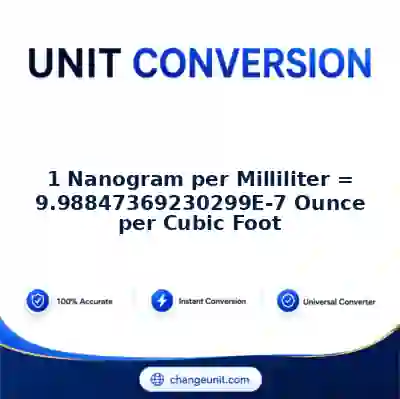
One Nanogram per Milliliter is equal to 0.000998847369230299 Ounce per Cubic Foot.
Formula: 1 ng/ml = 0.000998847369230299 oz/ft³
By using this conversion factor, you can easily convert any density measurement from nanogram per milliliter unit to ounce per cubic foot unit with precision.
How to Convert ng/ml to oz/ft³?
Converting from ng/ml to oz/ft³ is a straightforward process. Follow these steps to ensure accurate conversions from nanogram per milliliter to ounce per cubic foot:
- Select the Nanogram per Milliliter Value: Start by determining the nanogram per milliliter (ng/ml) value you want to convert into ounce per cubic foot (oz/ft³). This is your starting point.
- Multiply by the Conversion Factor: To calculate nanogram per milliliter to equivalent ounce per cubic foot amount, multiply the selected ng/ml value by 0.000998847369230299.
- Illustration of Multiplication:
- 1 ng/ml = 0.000998847369230299 oz/ft³
- 10 ng/ml = 0.009988473692 oz/ft³
- 100 ng/ml = 0.099884736923 oz/ft³
- Find the Conversion Result: The result of this multiplication is your converted value in ounce per cubic foot unit. This represents the same density but in a different unit.
- Save Your Ounce per Cubic Foot Value: After converting, remember to save the result. This value represents the density you initially measured, now expressed in ounce per cubic foots.
- Alternative Method – Division: If you prefer not to multiply, you can achieve the same conversion by dividing the nanogram per milliliter value by 1001.153961. This alternative method also gives you the correct density in ounce per cubic foots.
- Illustration of Division:
- oz/ft³ = ng/ml ÷ 1001.153961
What is Density?
Mass density is the amount of mass contained within a unit volume of a substance. It is commonly expressed in units such as kilogram per cubic meter (kg/m³), gram per cubic centimeter (g/cm³), and gram per milliliter (g/mL). Higher density indicates that more mass is packed into the same volume.
Mass density is widely used in engineering, material science, construction, manufacturing, geology, chemistry, and physics to identify materials, calculate loads, evaluate buoyancy, and analyze the physical properties of solids, liquids, and gases.
What is Nanogram per Milliliter?
What is Nanogram per Milliliter?
Nanogram per Milliliter (ng/mL) is a concentration unit that expresses the amount of a substance, measured in nanograms, present in one milliliter of a liquid. A nanogram is one-billionth of a gram, making this unit suitable for measuring extremely small concentrations that would be difficult to express using larger mass units.
Nanogram per Milliliter is widely used in medical laboratories, pharmaceutical research, toxicology, environmental science, and forensic investigations. Blood tests, drug monitoring programs, hormone analyses, and contamination studies often report results in ng/mL because many substances are present at very low concentrations. For example, laboratory reports may express medication levels, biomarkers, pesticides, or trace pollutants using this unit.
The unit is closely related to other concentration measurements such as Microgram per Liter (µg/L), Milligram per Liter (mg/L), Parts per Billion (ppb), and Parts per Million (ppm). In dilute aqueous solutions, Nanogram per Milliliter is numerically equivalent to Parts per Billion, which is why both units frequently appear in environmental monitoring reports and water quality regulations.
Because ng/mL combines a metric mass unit with a volume measurement, it provides a precise and internationally recognized way to report trace concentrations in liquids. Scientists, healthcare professionals, regulatory agencies, and laboratory technicians rely on this unit when accuracy is critical.
What is Ounce per Cubic Foot?
Some Nanogram per Milliliter to Ounce per Cubic Foot conversions
- 0.1 ng/ml = 0.0000998847369230299 oz/ft³
- 0.2 ng/ml = 0.0001997694738460598 oz/ft³
- 0.3 ng/ml = 0.0002996542107690897 oz/ft³
- 0.4 ng/ml = 0.0003995389476921196 oz/ft³
- 0.5 ng/ml = 0.0004994236846151495 oz/ft³
- 0.6 ng/ml = 0.0005993084215381794 oz/ft³
- 0.7 ng/ml = 0.0006991931584612093 oz/ft³
- 0.8 ng/ml = 0.0007990778953842392 oz/ft³
- 0.9 ng/ml = 0.0008989626323072691 oz/ft³
- 1 ng/ml = 0.000998847369230299 oz/ft³
- 2 ng/ml = 0.001997694738 oz/ft³
- 3 ng/ml = 0.002996542108 oz/ft³
- 4 ng/ml = 0.003995389477 oz/ft³
- 5 ng/ml = 0.004994236846 oz/ft³
- 6 ng/ml = 0.005993084215 oz/ft³
- 7 ng/ml = 0.006991931585 oz/ft³
- 8 ng/ml = 0.007990778954 oz/ft³
- 9 ng/ml = 0.008989626323 oz/ft³
- 10 ng/ml = 0.009988473692 oz/ft³
- 20 ng/ml = 0.019976947385 oz/ft³
- 30 ng/ml = 0.029965421077 oz/ft³
- 40 ng/ml = 0.039953894769 oz/ft³
- 50 ng/ml = 0.049942368462 oz/ft³
- 60 ng/ml = 0.059930842154 oz/ft³
- 70 ng/ml = 0.069919315846 oz/ft³
- 80 ng/ml = 0.079907789538 oz/ft³
- 90 ng/ml = 0.089896263231 oz/ft³
- 100 ng/ml = 0.099884736923 oz/ft³
Nanogram per Milliliter to Ounce per Cubic Foot Examples
Example 1:
Convert 0.8 Nanogram per Milliliter density to Ounce per Cubic Foot unit.
Solution:
We know that one Nanogram per Milliliter is equivalent to 0.000998847369230299 Ounce per Cubic Foot.
Therefore,
0.8 ng/ml = 0.8 x 0.000998847369230299 oz/ft³.
0.8 ng/ml = 0.0007990778953842392 oz/ft³.
Hence, 0.8 Nanogram per Milliliter is approximately equal to 0.0007990778953842392 Ounce per Cubic Foot.
Example 2:
Convert 8 Nanogram per Milliliter density to Ounce per Cubic Foot unit.
Solution:
We know that one Nanogram per Milliliter is equivalent to 0.000998847369230299 Ounce per Cubic Foot.
Therefore,
8 ng/ml = 8 x 0.000998847369230299 oz/ft³.
8 ng/ml = 0.007990778954 oz/ft³.
Hence, 8 Nanogram per Milliliter is approximately equal to 0.007990778954 Ounce per Cubic Foot.
Frequently Asked Questions
How do you convert ng/ml to oz/ft³ formula?
The main formula for the conversion of the ng/ml value to oz/ft³ amount is to multiply the ng/ml value by 0.000998847369230299.
There are 0.000998847369230299 Ounce per Cubic Foot in 1 Nanogram per Milliliter.To convert from Nanogram per Milliliter to Ounce per Cubic Foot, multiply your figure by 0.000998847369230299 (or divide by 1001.153961).
What is the relation between Nanogram per Milliliter and Ounce per Cubic Foot?
The relationship between Nanogram per Milliliter and Ounce per Cubic Foot is given as follows: 1 ng/ml = 0.000998847369230299 oz/ft³
What is the value of 1 Nanogram per Milliliter in equivalent Ounce per Cubic Foot?
1 Nanogram per Milliliter density is equivalent to 0.000998847369230299 Ounce per Cubic Foot density.
What is the nanogram-per-milliliter in ounce-per-cubic-foot?
1 nanogram-per-milliliter equals 0.000998847369230299 ounce-per-cubic-foots.
What is the value of 15 Nanogram per Milliliter in Ounce per Cubic Foots?
We know that 1 Nanogram per Milliliter is equal to 0.000998847369230299 Ounce per Cubic Foot, multiply 15 by 0.000998847369230299 Ounce per Cubic Foot. Therefore, 15 Nanogram per Milliliter = 15 x 0.000998847369230299 Ounce per Cubic Foot, 15 ng/ml = 0.014982710538 oz/ft³. Hence, the value of 15 Nanogram per Milliliter in Ounce per Cubic Foot is 0.014982710538 oz/ft³.
What Density is 1 oz/ft³?
The Density of 1 oz/ft³ spans 1001.153961 Nanogram per Milliliter.
1 ng/ml how much ounce-per-cubic-foot?
1 Nanogram per Milliliter (ng/ml) corresponds to 0.000998847369230299 Ounce per Cubic Foot (oz/ft³).