Convert Picogram per Milliliter to Pound per Imperial Gallon (UK) (pg/ml to lb/imp gal)
Picogram per Milliliter (pg/ml) and Pound per Imperial Gallon (UK) (lb/imp gal) are both units of density. With the conversion form below, you can effortlessly and accurately convert picogram per milliliter to pound per imperial gallon (uk). This free online calculator tool makes it simple and easy to perform the conversion from pg/ml unit to the lb/imp gal unit.
Picogram per Milliliter to Pound per Imperial Gallon (UK) conversion
Picogram per Milliliter to Pound per Imperial Gallon (UK) Conversion Formula
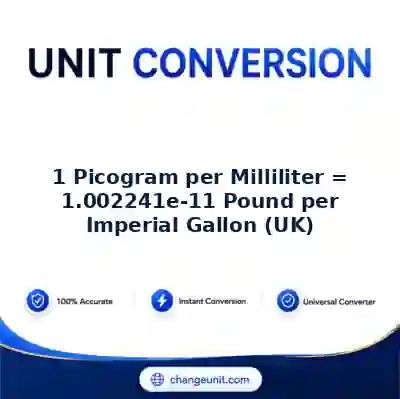
One Picogram per Milliliter is equal to 0.0000000100224128549606 Pound per Imperial Gallon (UK).
Formula: 1 pg/ml = 0.0000000100224128549606 lb/imp gal
By using this conversion factor, you can easily convert any density measurement from picogram per milliliter unit to pound per imperial gallon (uk) unit with precision.
How to Convert pg/ml to lb/imp gal?
Converting from pg/ml to lb/imp gal is a straightforward process. Follow these steps to ensure accurate conversions from picogram per milliliter to pound per imperial gallon (uk):
- Select the Picogram per Milliliter Value: Start by determining the picogram per milliliter (pg/ml) value you want to convert into pound per imperial gallon (uk) (lb/imp gal). This is your starting point.
- Multiply by the Conversion Factor: To calculate picogram per milliliter to equivalent pound per imperial gallon (uk) amount, multiply the selected pg/ml value by 0.0000000100224128549606.
- Illustration of Multiplication:
- 1 pg/ml = 0.0000000100224128549606 lb/imp gal
- 10 pg/ml = 0.0000001002241285496060 lb/imp gal
- 100 pg/ml = 0.00000100224128549606 lb/imp gal
- Find the Conversion Result: The result of this multiplication is your converted value in pound per imperial gallon (uk) unit. This represents the same density but in a different unit.
- Save Your Pound per Imperial Gallon (UK) Value: After converting, remember to save the result. This value represents the density you initially measured, now expressed in pound per imperial gallon (uk)s.
- Alternative Method – Division: If you prefer not to multiply, you can achieve the same conversion by dividing the picogram per milliliter value by 99776372.6631. This alternative method also gives you the correct density in pound per imperial gallon (uk)s.
- Illustration of Division:
- lb/imp gal = pg/ml ÷ 99776372.6631
What is Density?
Mass density is the amount of mass contained within a unit volume of a substance. It is commonly expressed in units such as kilogram per cubic meter (kg/m³), gram per cubic centimeter (g/cm³), and gram per milliliter (g/mL). Higher density indicates that more mass is packed into the same volume.
Mass density is widely used in engineering, material science, construction, manufacturing, geology, chemistry, and physics to identify materials, calculate loads, evaluate buoyancy, and analyze the physical properties of solids, liquids, and gases.
What is Picogram per Milliliter?
What is Pound per Imperial Gallon (UK)?
Some Picogram per Milliliter to Pound per Imperial Gallon (UK) conversions
- 0.1 pg/ml = 0.00000000100224128549606 lb/imp gal
- 0.2 pg/ml = 0.00000000200448257099212 lb/imp gal
- 0.3 pg/ml = 0.00000000300672385648818 lb/imp gal
- 0.4 pg/ml = 0.00000000400896514198424 lb/imp gal
- 0.5 pg/ml = 0.00000000501120642748030 lb/imp gal
- 0.6 pg/ml = 0.00000000601344771297636 lb/imp gal
- 0.7 pg/ml = 0.00000000701568899847242 lb/imp gal
- 0.8 pg/ml = 0.00000000801793028396848 lb/imp gal
- 0.9 pg/ml = 0.00000000902017156946454 lb/imp gal
- 1 pg/ml = 0.0000000100224128549606 lb/imp gal
- 2 pg/ml = 0.0000000200448257099212 lb/imp gal
- 3 pg/ml = 0.0000000300672385648818 lb/imp gal
- 4 pg/ml = 0.0000000400896514198424 lb/imp gal
- 5 pg/ml = 0.0000000501120642748030 lb/imp gal
- 6 pg/ml = 0.0000000601344771297636 lb/imp gal
- 7 pg/ml = 0.0000000701568899847242 lb/imp gal
- 8 pg/ml = 0.0000000801793028396848 lb/imp gal
- 9 pg/ml = 0.0000000902017156946454 lb/imp gal
- 10 pg/ml = 0.0000001002241285496060 lb/imp gal
- 20 pg/ml = 0.0000002004482570992120 lb/imp gal
- 30 pg/ml = 0.0000003006723856488180 lb/imp gal
- 40 pg/ml = 0.0000004008965141984240 lb/imp gal
- 50 pg/ml = 0.0000005011206427480300 lb/imp gal
- 60 pg/ml = 0.0000006013447712976360 lb/imp gal
- 70 pg/ml = 0.0000007015688998472420 lb/imp gal
- 80 pg/ml = 0.0000008017930283968480 lb/imp gal
- 90 pg/ml = 0.0000009020171569464540 lb/imp gal
- 100 pg/ml = 0.00000100224128549606 lb/imp gal
Picogram per Milliliter to Pound per Imperial Gallon (UK) Examples
Example 1:
Convert 0.2 Picogram per Milliliter density to Pound per Imperial Gallon (UK) unit.
Solution:
We know that one Picogram per Milliliter is equivalent to 0.0000000100224128549606 Pound per Imperial Gallon (UK).
Therefore,
0.2 pg/ml = 0.2 x 0.0000000100224128549606 lb/imp gal.
0.2 pg/ml = 0.00000000200448257099212 lb/imp gal.
Hence, 0.2 Picogram per Milliliter is approximately equal to 0.00000000200448257099212 Pound per Imperial Gallon (UK).
Example 2:
Convert 3 Picogram per Milliliter density to Pound per Imperial Gallon (UK) unit.
Solution:
We know that one Picogram per Milliliter is equivalent to 0.0000000100224128549606 Pound per Imperial Gallon (UK).
Therefore,
3 pg/ml = 3 x 0.0000000100224128549606 lb/imp gal.
3 pg/ml = 0.0000000300672385648818 lb/imp gal.
Hence, 3 Picogram per Milliliter is approximately equal to 0.0000000300672385648818 Pound per Imperial Gallon (UK).
Frequently Asked Questions
How do you convert pg/ml to lb/imp gal formula?
The main formula for the conversion of the pg/ml value to lb/imp gal amount is to multiply the pg/ml value by 0.0000000100224128549606.
There are 0.0000000100224128549606 Pound per Imperial Gallon (UK) in 1 Picogram per Milliliter.To convert from Picogram per Milliliter to Pound per Imperial Gallon (UK), multiply your figure by 0.0000000100224128549606 (or divide by 99776372.6631).
What is the relation between Picogram per Milliliter and Pound per Imperial Gallon (UK)?
The relationship between Picogram per Milliliter and Pound per Imperial Gallon (UK) is given as follows: 1 pg/ml = 0.0000000100224128549606 lb/imp gal
What is the value of 1 Picogram per Milliliter in equivalent Pound per Imperial Gallon (UK)?
1 Picogram per Milliliter density is equivalent to 0.0000000100224128549606 Pound per Imperial Gallon (UK) density.
What is the picogram-per-milliliter in pound-per-imperial-gallon-uk?
1 picogram-per-milliliter equals 0.0000000100224128549606 pound-per-imperial-gallon-uks.
What is the value of 15 Picogram per Milliliter in Pound per Imperial Gallon (UK)s?
We know that 1 Picogram per Milliliter is equal to 0.0000000100224128549606 Pound per Imperial Gallon (UK), multiply 15 by 0.0000000100224128549606 Pound per Imperial Gallon (UK). Therefore, 15 Picogram per Milliliter = 15 x 0.0000000100224128549606 Pound per Imperial Gallon (UK), 15 pg/ml = 0.0000001503361928244090 lb/imp gal. Hence, the value of 15 Picogram per Milliliter in Pound per Imperial Gallon (UK) is 0.0000001503361928244090 lb/imp gal.
What Density is 1 lb/imp gal?
The Density of 1 lb/imp gal spans 99776372.6631 Picogram per Milliliter.
1 pg/ml how much pound-per-imperial-gallon-uk?
1 Picogram per Milliliter (pg/ml) corresponds to 0.0000000100224128549606 Pound per Imperial Gallon (UK) (lb/imp gal).